
SAPs in Action - Mexico, Structural Adjustment Programmes: Part 2
Spreadsheet economics and ignoring history

In Part 1 of this series, we explored the ideological lineage of SAPs, how they went from the minds of the Western academic elites to policy proscriptions that were enforced all around the world.
Mexico was perhaps the first Latin American country to get the full force of these ideas; however, as we’ll see, they didn’t become the shining example of SAPs that the IMF and World Bank had hoped.
Mexico’s economic history is one filled with the same story: a working class that has been ignored, deprioritised, and marginalised by nearly every version of development that has been applied.
In 1917, Mexico entrenched a state-led nationalist approach to development through Article 27, which provided the legal basis for state control over crucial industries such as agriculture and natural resources.
From 1940 to 1970, Mexico embarked on a journey through what is called Import Substitution Industrialisation (ISI) through a series of six-year plans.
This is referred to more broadly through political economy discourse as the “Mexican Miracle” and was overseen by the Institutional Revolutionary Party.
The period from 1917 to 1982 is rich with history, and there isn’t enough space here to share the whole history, but the crucial point is that the state-led development led to growth of 6% over the period 1940–1970, but with strong caveats for the working classes.
To be clear, this wasn’t socialism; this was industrial, state-led capitalism.
A crucial figure in Mexico’s history, Zapata was assassinated in 1919, two years after the 1917 constitution. A man of the people, Zapata called for agrarian land reform and wanted to see localised control over land by the peasantry.
This growth didn’t find its way into their hands, and Mexico oversaw a heavily centralised, oppressive regime that culminated in the massacres of 1968 and 1971.
By 1982, Mexico was hugely overexposed to global markets from an overreliance on oil, and it defaulted on its debts, which it had racked up through the 1970s by aggressive public financing of PEMEX, relying on future oil revenues that never came.
The Volcker Shock of 1979 and the oil crash of 1982 ensured Mexico’s debt-driven development culminated in crisis.
It was clear that the Mexican state had to change tack in the 1980s.
In stepped the IMF and World Bank with a solution.
Khor and Kalter - More Capitalism
Hoe Ee Khor and Eliot Kalter, both ex-IMF economists, in a document released in 1990 for the IMF, discuss the background to Mexico’s “restructuring”.
This document reads almost like a novel, with protagonists—the IMF, the World Bank, the USA—and antagonists—the Mexican government, inflation, “macroeconomic imbalances and structural rigidities”, and in one case, a pesky earthquake.
They frequently use technocratic and academic language like “performance”, “efficiency”, and “harmonising”, and often veer into the realm of chummy camaraderie by saying things like “supported by the Fund”, describing “the Fund’s [approval]” of a three-year extended “arrangement”, and talk about how “the authorities sought and obtained financial support from the international community”.
They talk about the Mexican economy like a dog trainer would describe your Rottweiler—it needed “correcting” through “measures” and putting on a “program”.
For Mexico, structural adjustment looked like this:
Liberalisation of Trade
Reduction in state owned enterprise
Tax reform
Liberalisation of the financial sector
Huge increase in FDI and liberalisation of FDI
Deregulation
Mexico’s relationship with the IMF actually starts somewhat ominously in the 1970s, following debt issues. Khor and Kalter put this down to “a policy of increased government intervention in economic affairs, high fiscal deficits, and rigid exchange rate policies”.
The IMF aren’t necessarily wrong in this analysis, but it does miss out a huge nuance in Mexican history and actually deepens a critical issue in Mexican development—its colonial history—and this is important for how the IMF and the World Bank move forward.
This has played out in development literature for decades. Where you sit on this depends very much on how much you attribute the successes or the failures of post-colonial economies to their management of a post-colonial society, which was nearly always one of chaos, confusion, and a seriously imbalanced set of institutions and ideas that originated from Europe.
The IMF and the World Bank looked at the state-led approach since 1917 and ignored a crucial point: the peasantry, the working classes, and the indigenous communities didn’t get a say in their own development.
Colonial History
Like a lot of Latin America, the Mexican experience is impacted heavily by the arrival of the Spanish in 1519.
The Spanish led a reign of terror over the area that is now Mexico; through disease and violence, they reduced the indigenous population by up to 90%.
They formally gained independence in 1821, but this colonial relationship didn’t disappear with it.
Instead, it was nationalised as two new classes emerged and took control of state power—the criollos and the mestizos.
The criollos are people of pure Spanish descent who were born in the Americas; the mestizos are of mixed European (predominantly Spanish) and indigenous heritage.
After they gained formal independence, and since the Mexican Revolution of 1910, control of the state has been in their hands, and the indigenous population was seen as something to be “integrated” within it.
As Rosabala Icaza states, “The beneficiaries of this project of nation and state building were far from being the originary (sic) owners of the lands called Mexico”.
The story of Mexico is a complicated one. The IMF and the World Bank either choose to disregard, or simply do not care about, this history.
This highlights a critical issue with the perceived neutrality of these economic policies. By reducing the country to a set of statistics on a spreadsheet, the IMF and the World Bank only further entrench these historical divisions within the country, ensuring any benefits that are realised are not enjoyed by the indigenous working classes who need them the most.
In a now declassified World Bank document, a review of SAPs in Mexico by NGOs led by Carlos Heredia, we can see how the indigenous working class is once again left out of the equation.
In this document, they don’t beat around the bush:
”The net effect of the adjustment program on the population groups considered in this study is negative. Not only has adjustment not contributed to an improvement in their standard of living, but it has threatened their very livelihood”
Mexico’s Forgotten Class - Chihuahua
Chihuahua paints a vivid picture of how SAPs affected everyday life for Mexico’s urban and rural working classes and indigenous communities.
Chihuahua is Mexico’s largest state and is characterised by mountains and deep, arid valleys. Growing things here can be difficult, but historically agriculture has played a crucial role in the economy, the politics, and society of Mexico.
Prior to the Mexican Revolution, 70% of the country’s arable land was controlled by 1% of the population. Following the revolution, land reforms established “ejidos”, which are state-owned, farmer-controlled plots of land. The intention here was to prevent elites from recapturing this land through private sale.
Whilst far from ideal, this created political stability within rural communities and established a stable bargain between the state and the farmers. It gave them access to subsidies, cheap credit, and guaranteed prices so they could produce beans and corn for the domestic market, while the state invested heavily in agro-export.
SAPs disrupted this dynamic, with little regard for the political sensitivity of this, or for the lives and families of the 3 million families that lived and worked across 28,000 ejidos.
As part of a “modernisation” effort across rural Mexico, starting in 1991, corporations and private interests could now convert ejidos into private property, and the land was put up for sale.
The subsidies stopped, as SAPs ensured over 90% of the state-owned enterprises were privatised throughout Mexico.
Access to cheap credit was cut off, and they saw an end to guaranteed prices, as trade liberalisation shifted the agriculture sector even more towards export, in an attempt to raise enough foreign exchange to import food more cheaply than it could be produced domestically.
Without fixed prices, farmers were at the whim of the free market; without subsidies, farmers couldn’t rely on a stable income; and without cheap credit, farmers quickly found themselves in unsustainable levels of debt in order to cover all the costs of each harvest.
Here we see a familiar story: what happens to people when they can’t provide for their families from their land anymore?
First, they’re forced to go into the cities to look for different forms of work. This primarily looks like foreign-owned factories, or “maquiladoras”, which had been growing since before adjustment but were accelerated by SAPs.
If that isn’t viable, the next obvious choice is to try and find work in America, across the border, and have someone send money home
Removed from direct control over their own means of subsistence, people are coerced into finding it through wage labour.
Here is an account from Martha Hernández de González:
“My husband is always here during planting season, but the rest of the year he spends working in the United States. He and four children in Texas, Florida, Colorado and New Mexico take care of all the family expenses and they take turns helping with the planting. When we are short of money, my husband and my children are contracted to work in the apple orchards or to do some other work in the countryside”
The Empirical Picture
Using OECD data from 2014, we can see the end-state distributional effects of these changes on rural Chihuahua, reflecting the impact of SAPs and demonstrating that while they may make improvements on paper, it’s the distribution of those paper improvements that really reflects their impact on real people.
As the rural community is forced to either cross the border or find work in an urban setting, their subjective experience of SAPs doesn’t yield across-the-board improvements.
Here we see the OECD data for Chihuahua in 2014, relative to the other 31 states within Mexico.
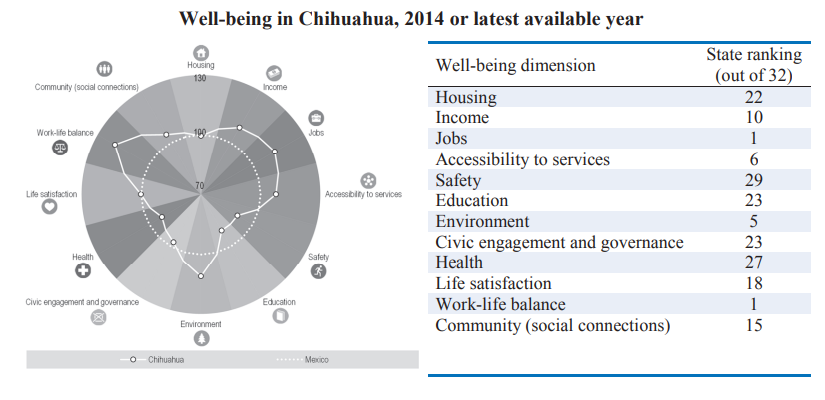
It’s worth noting that a score of “1” here for key well-being indicators like housing, education, and health is still below Global North averages.
For example, the top-ranked state for educational attainment is the Federal State, with only 60% of its workforce.
For housing, “Only 44 out of the 362 OECD regions had, on average, less than one room per person in 2010; half of them are Mexican states”. The best performer in Mexico averages 1.15 rooms per person.
For health, “In 14 states and the Federal District, the maternal mortality rate was above 40 deaths per 100,000 live births in 2013, and only in Nuevo León was it below 15, a value comparable to that of Chile and Turkey”.
Interestingly, “community” is defined as the percentage of people who have at least one friend to rely on in case of need.
While we can see on paper economic improvements such as relatively high employment, above-average incomes, strong access to services, and exceptionally high work–life balance in Chihuahua, we also see that the distribution of these gains does not translate into broad social improvements, with persistently low outcomes in safety, education, health, and life satisfaction compared to national, and particularly international, averages.
After decades of neoliberal policy, people in Chihuahua have poor overall health despite relatively high access to healthcare, high infant mortality, high maternal mortality, low access to suitable housing, have seen a dramatic increase in homicide, have low voter turnout, and have some of the lowest access to education in the country.
Real Life vs Economic Theory
The approach from the IMF and the World Bank systematically excludes historical and distributive contexts. When economics is focused on macro-level outcomes favouring assimilation into a homogenous global system, it is the working class who suffer.
In the Mexican context, structural adjustment is agnostic to the needs of humans. It is structured around achieving very clear, specific goals: trade liberalisation, reduction of state power and involvement in the economy, financialisation, and deregulation.
SAPs represent the spreadsheet mentality of neoliberal economics—the complete and utter disconnection from people into the abstract world of aggregate numbers, taking a sharp turn away from distributive outcomes and leaning heavily into modelled targets.
If the right numbers go up, the people in the street do not matter.
It takes the lessons learned from real human subjugation through force and turns them into coercion through forced behavioural levers.
Mexico follows a pattern very familiar in Latin America: colonisation, displacement, replacement, independence consolidated under neo-colonial interests, and restructuring to serve the imperial core.
During every step of the process, it is the working classes, rural communities, and indigenous populations who suffer.
The IMF and the World Bank had no interest in lifting up working people.
Since the arrival of the Spanish, elite power structures in Mexico have repeatedly and systematically marginalised indigenous populations from political and economic decision-making.
SAPs in Mexico actually amplified existing distributional asymmetries that were rooted in a colonial history of exploitation, cultural replacement, and ethnic assimilation.
This long-run exclusion is reflected in the disproportionately poor outcomes experienced by indigenous and rural communities today.
This 5 part series will cover
Part 1: From theory to policy - how ideas are never neutral - Read here!
Part 2: SAPs in action - A case study from Latin America
Part 3: SAPs in action - A case study from Sub Saharan Africa
Part 4: SAPs in action - A case study from South East Asia
Part 5: The Legacy of SAPs - How SAPs cemented an ideology
I’d love to do this full time and not be weighed down my corporate job, so I can read, learn and write more. You can help me do this by following me across social media, buying me a coffee or becoming a paid subscriber -
Instagram
TikTok
Link Tree
Buy me a coffee
Another nice piece in the series Alex. It really reflects how just taking a one-size-fits-all sort of approach via required austerity, restrictions of easy access to capital and credit to common folks, and reordering of the financial priorities of a state, can never then reflect the social realities, and historical context of any given nation.
I really appreciated your reference to the effects in the 80s of rising migration. It reflects how US influence and policy through their institutional arms at the IMF, has contributed massively to the "migrant crisis" in a much more insidious way than just the traditional narrative of imperial overreach and US destructiveness in Latin America.