
There Is No Outside: What The Devil Wears Prada Gets Right About Capitalism
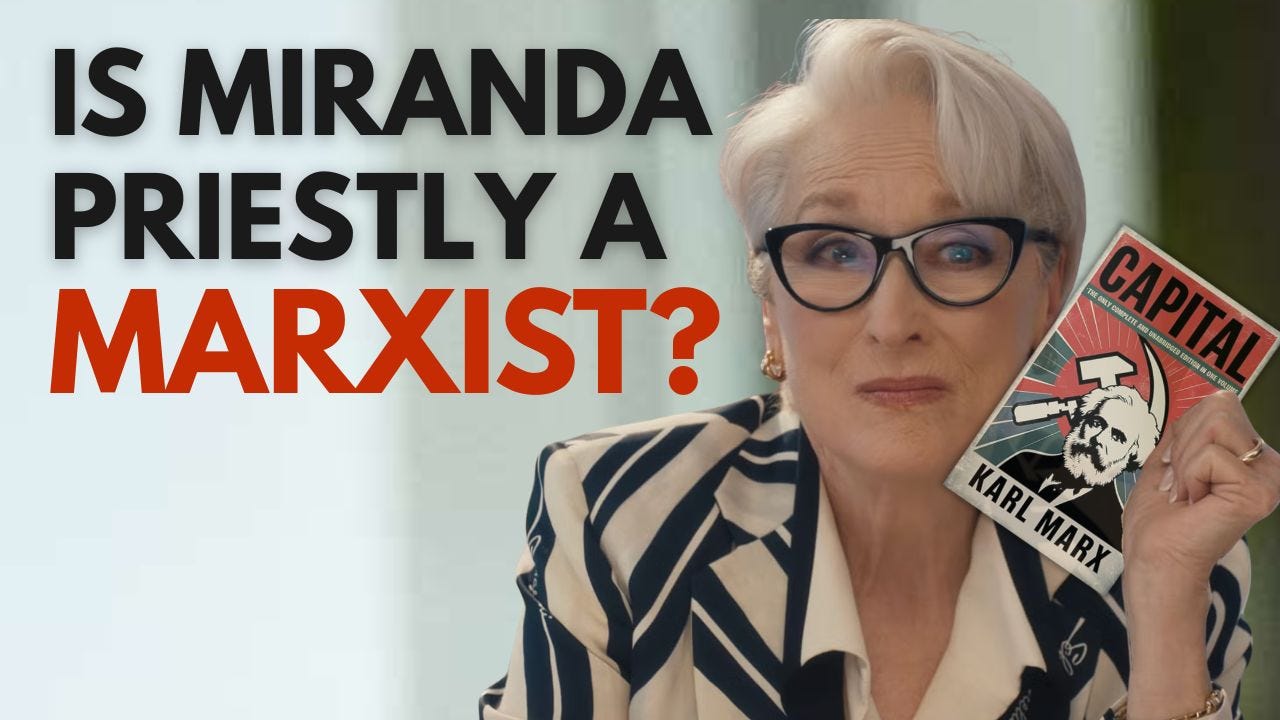
Is Miranda Priestly a Marxist?

In the popular 2006 film The Devil Wears Prada, Miranda Priestly, the primary antagonist, played brilliantly by Meryl Streep, is the editor-in-chief of the luxury fashion magazine Runway.
She runs an empire built on exclusivity, aspiration, and the labour of people she neither notices nor cares about. She decides who gets to work and who doesn’t, what gets made and who gets to wear it. She is, in the most straightforward sense, a humongous capitalist.
However, there is a scene in The Devil Wears Prada - the one about the cerulean blue jumper1 - that is a brutally honest illustration of a Marxist argument that demonstrates the real-world consequences of control over the means of production2.
The content of what Miranda says demonstrates the real-world version of an argument Karl Marx made in the Grundrisse in 1857 about the relationship between production and consumption.
What she describes as a linear chain with a top and a bottom, presented as a natural order, Marx describes as the circular and misrecognised structure of capitalist production.
Watch this now iconic scene here.
From a Pile of “stuff”
Andy Sachs, played by Anne Hathaway, joins the magazine as a junior assistant to Miranda, hoping to leverage the connections for a shot at journalism. She’s made a point of not caring too much about fashion - her clothes are functional, chosen without much care.
She clearly thinks the concept of high fashion is ridiculous, and the audience is brought along on that journey with her. During a decision Miranda is making over two belts, Andy sniggers at the concept that the two belts are in any way different.
Miranda identifies the specific shade of blue of a jumper3 Andy is wearing - cerulean blue - and traces its history from its production through to its consumption on Andy’s body. That colour did not appear in the distribution network by accident.
It began in a room very similar to the one Andy is standing in during the scene, and then to a runway. It was deliberately decided upon by a small group of people in the fashion industry. It moved from there into department stores, then into high-street retail, and eventually into the discount end of the market, where Andy came across it and selected it to reflect her nonchalance of fashion.
Miranda’s conclusion is direct: Andy believes she has opted out of the system by choosing something that wasn’t trending. However, as Miranda brutally points out, she has not. She has received one of its outputs, slightly delayed, and has mistaken the distance between herself and the source of independence from it.
What Marx Said
In the Grundrisse, Marx argues that production, distribution, exchange, and consumption are not separate, independent activities. They are moments within a single process. We tend to think of consumption as the endpoint - you buy a thing, you use it, you’re done. But Marx insists that consumption is not separate from production; it is shaped by it, often produced by it.
More specifically, Marx argues that production “creates the consumer.” It does not merely create objects for pre-existing needs; it produces the needs themselves. The system generates not just goods but desires, preferences, and the very categories through which people understand what they want. The consumer’s perception that they are at the “end” of the chain and that they arrived there freely is not accurate. They were produced by everything that came before them.
This is precisely what Miranda is demonstrating. Andy didn’t just happen to want a cerulean jumper4. The cerulean jumper exists, at that price point, in that shop, as a direct result of decisions made years earlier by people Andy has never met, working in institutions Andy has never thought about. A process formed her preference, which she was not party to and had no control over.
The specific aesthetic language Miranda is using - the idea that the runway decision determines what eventually ends up in the clearance bin - is a description of how production shapes consumption across time and down through the price hierarchy.
We can’t privilege any single node in the production chain any more than you can separate the river bank from being shaped by the river, which in turn reshapes the river.
The person who perceives themselves to be at the bottom of that chain, the one who picks things up in the discount aisle, is no freer from the system than the person who buys at full price. They are just further downstream.
Control Over the Means of Production
What makes this argument significant is not just that it applies to fashion. It applies to every domain of consumption in a capitalist economy. Miranda has laid it out in very material, relatable terms.
She delivers it almost as a smug take-down of the illusion of subcultural individuality. As someone who has always tried to live “outside” of capitalist production, I remember this scene annoying me when I first watched it. I felt it was attacking my attempt at “opting out” because she’s right. I wasn’t.
The company that makes all of my “alternative” clothes and produces my skateboards and distributes my edgy music are still a huge capitalist companies that only care about profit. I was just another consumer produced by production itself, given a range of “choices”, and I opted for the one that I felt represented opting out.
What looks like a choice is actually a product of a very specific set of industrial and political decisions, made a long time ago, way upstream of you. You are the result of that production chain, and your decision sends a signal back to the top, and round we go again.
Marx’s point, and Miranda’s point, is that the person who believes they have opted out of a system by making unconventional “choices” within it has both has failed to recognise the circular nature of production, and mistaken their direction of travel within it. Andy thinks she exists as a dam, inertly blocking the flow of water, but she is just another bend in the river.
There is no outside. The “outside” you think you’ve found is just a corner of the inside that doesn’t hold enough cultural capital to command a high enough price, or hasn’t manufactured a big enough subculture to consume it.
How our Culture Valorises this Control
The film presents Miranda’s speech as a kind of revelation - and in terms of cinematic effect, it is. It is delivered with such precision and authority that many viewers come away feeling that Miranda is right, that Andy was naïve, and that the fashion industry is more serious than it first appeared. Meryl Streep has to take a lot of credit for that.
What Miranda has actually told us is that a small group of capital owners in a single industry decided, years in advance, what a young woman in New York would be wearing on an ordinary Tuesday. And she presents this as how things work.
Miranda is not making a critique of the system. She is asserting her position within it. The subtext of the speech is: I am one of the people in those rooms. I make these decisions. You should understand what that means and respect it.
She’s proud of this power. The film, at this moment, invites us to share in that pride - or at least to be awed by it.
The awe the scene generates is the same as the awe that the system itself generates. We are meant to feel that Miranda’s power is impressive, even as she is explaining to us, in plain terms, how that power operates to determine the choices of people who never consented to it.
This is the sleight of hand, she is saying the quietest part out loud, but we’ve become so culturally enamoured with it we can’t see it for how deeply problematic, undemocratic and authoritarian it is.
The Balance of Power and Ownership
Miranda’s power is individual and unaccountable. She decides, and the industry follows, and nobody votes on any of it or questions her. The productive resources of an entire industry - the labour, the capital, the cultural influence - flow according to the preferences of a single person operating within an ownership structure that was never democratically determined.
Andy decides by the end of the film that she doesn’t want to be like Miranda; her reasons are based on an individualistic view of the world. She concludes that Miranda has spent way too much of her moral capital to get and maintain that position, but the allure of the position is real. Andy fails to reckon with the fact that Miranda is a structural inevitability.
Miranda’s power is real. The analysis she offers is, structurally, correct. But the conclusion she draws from it - that this is how things are and should be, and that the appropriate response is deference - is wrong. This is implicit throughout the film, “where so many people would die to work, you only deign to work” a character tells Andy during a heart-to-heart, and this is the problem.
We aren’t offered an alternative; the choices we face are - be a bad person and become an authoritarian, or stick to your moral compass and…ignore it? The irony is that Andy is an aspiring journalist; she’s been in the belly of the beast and is the best placed of anyone in that film to reckon with this reality.
The fact that production shapes consumption, and that ownership of the means of production confers enormous and largely invisible power over people’s lives, is an argument for changing who controls production. Not for admiring those who currently do and deciding whether or not that’s the type of person you want to be.
I’d love to do this full-time and not be weighed down by my corporate job, so I can read, learn and write more. You can help me do this by sharing this with your community, buying me a coffee or becoming a paid subscriber. Your contributions help to cover key subscriptions, books and articles.
YouTube
Instagram
TikTok
Link Tree
Buy me a coffee
Sweater
The “means of production” refers to everything required to make goods and services - factories, machinery, land, raw materials, and technology.
Sweater
Sweater
Great video. A couple of thoughts:
1) When you consider how our food preferences are shaped by gut bacteria, we don't really have agency even at the level of consumption. 😅
2) Have you ever seen Google's "Selfish Ledger" video? There's a subtle part in it which basically lays out the case for this whole process from production to consumption being steered by their algorithms. Not for its own sake, but as a way of collecting even more data on people. Manufacturing an IOT scale in real time (3D printing it) tailored to the consumer's algorithmically extracted preferences in order to determine the person's weight. Crazy shit.
3) To your point about the people deciding, this is what my work is all about, and I focus specifically on land and its use as the key point of intervention. I won't self-promote here but it's my essay on permaculture and participatory governance. You may find it interesting.